

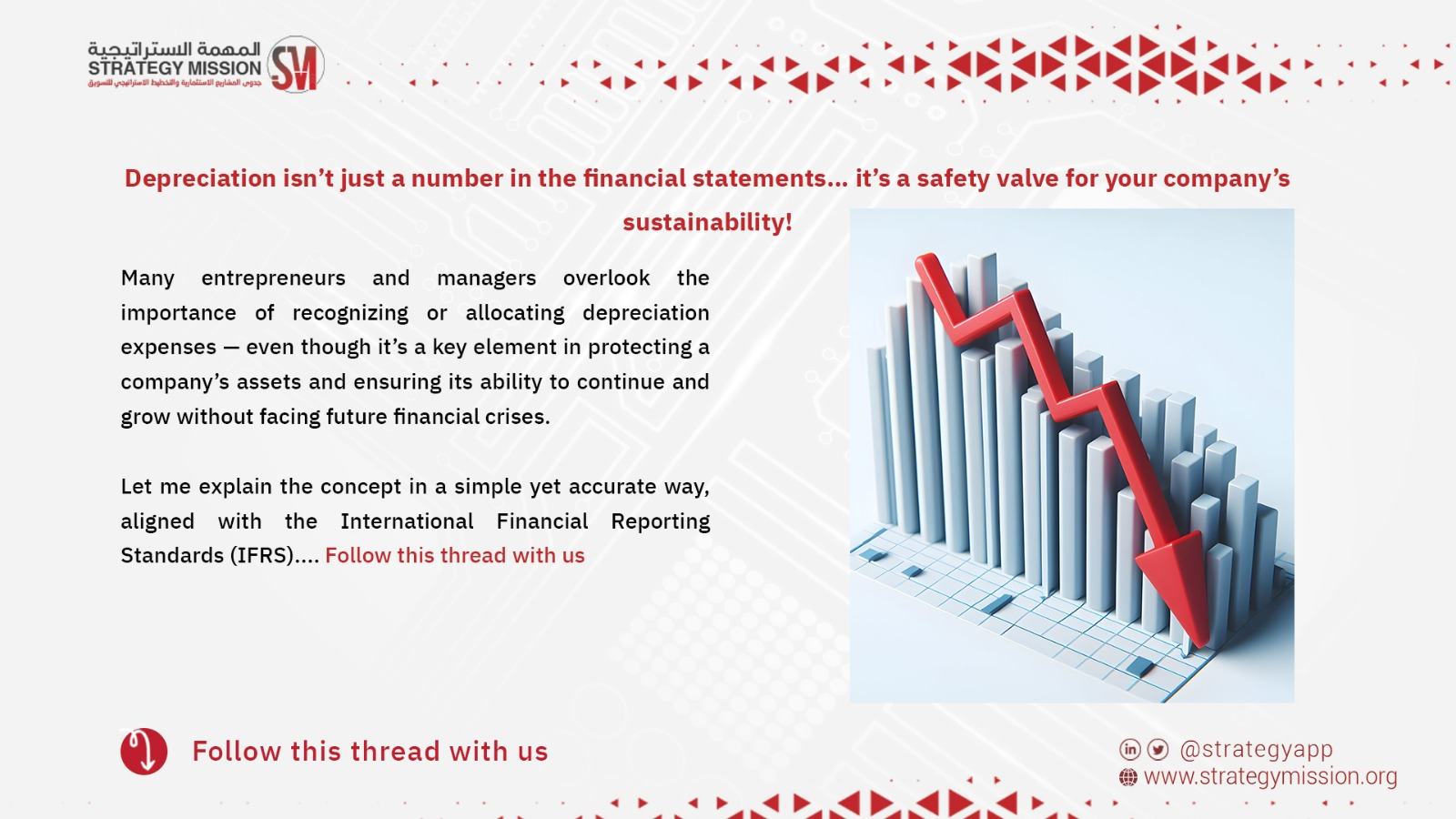
Depreciation: Meaning and Importance in Accounting under IFRS
Depreciation is not just a figure on your financial statements — it’s a safety valve that ensures your company’s sustainability and asset protection. Ignoring depreciation or spending its amount as profit can expose your business to serious financial risks in the future.
🔗 As always, before we begin, we’d like to remind you that for professional feasibility study services, corporate governance, ISO certification preparation, and free preliminary consultation, you can reach out through:
- Strategy Mission service request form
- Or contact Eng. Mohammed Agha directly via WhatsApp
What Is Depreciation?
Depreciation is the systematic allocation of the cost of a fixed asset (like a car, machine, or furniture) over its useful life — the period during which the asset provides economic benefits to the business.
For example, if you purchase equipment worth SAR 100,000 that lasts 5 years, you should deduct SAR 20,000 from your profits each year. This approach reflects the true asset value and ensures you can replace it once it’s worn out.
Depreciation and IFRS Standards
According to IAS 16 under the International Financial Reporting Standards (IFRS), every company must:
- Determine the useful life of each asset based on actual usage.
- Estimate its residual (salvage) value, if any.
- Select a depreciation method that best reflects how the asset is used.
- Review these estimates annually and adjust them if usage patterns change.
This ensures consistency, transparency, and compliance with international accounting standards.
Useful Life of Fixed Assets
The useful life — and therefore the depreciation period — varies depending on the asset type:
- Vehicles: 4–5 years
- Electronics: 3–5 years
- Furniture and fixtures: 5–7 years
- Industrial machinery: 7–15 years
- Buildings: 20–50 years
You should set these estimates based on your actual operating conditions rather than random market averages.
Methods of Calculating Depreciation
Under IFRS, there are three main methods to calculate depreciation:
- Straight-line method: Allocates equal depreciation expense each year (most common).
- Declining balance method: Applies a fixed percentage to the asset’s remaining book value annually.
- Units of production method: Based on actual hours used or production output.
The chosen method should reflect how the asset’s economic benefits are consumed over time.
Why Depreciation Is Important
Properly recording depreciation has a major impact on your company’s financial health. It affects:
- The accuracy of reported profits.
- Your ability to replace assets without financial stress.
- Your credibility with investors and banks.
- Compliance with IFRS and global accounting standards.
- The reliability of feasibility studies and investment analyses.
The Risk of Ignoring Depreciation
Many small businesses record depreciation in their books but spend the amount as part of their profits. After a few years, they face:
- Broken-down vehicles and outdated equipment.
- Production stoppages due to asset failures.
- No reserve funds available for replacements.
Practical Example
Let’s say a company buys a machine for SAR 600,000 with a useful life of 6 years and a residual value of SAR 60,000.
Annual Depreciation = (600,000 − 60,000) ÷ 6 = SAR 90,000 per year.
This amount should be deducted from profits and saved as a reserve for purchasing a new machine after six years.
Conclusion: Depreciation Protects Your Business Sustainability
Applying depreciation correctly isn’t just an accounting requirement — it’s a vital financial safeguard. It ensures fair reporting, supports sustainable growth, and prepares your company for future investments. Always review your depreciation estimates annually and stay compliant with IFRS standards for optimal financial performance.
For more insights about the importance of feasibility studies or to request professional financial consulting, visit Strategy Mission or contact Eng. Mohammed Agha directly.

No comment